M Abdul Rehman

NEW YORK — The dollar sputtered Tuesday on the eve of a US decision on monetary policy, while the yen rose sharply on risk aversion after weaker-than-expected economic data from China.

The euro edged up to 1.4150 dollars at 2100 GMT from 1.4135 dollars in New York late on Monday.

The dollar fell to 95.99 yen from 97.17 yen late Monday.

Financial markets were awaiting the outcome of the US Federal Reserve's two-day policy meeting, which kicked off on Tuesday.

The Federal Open Market Committee (FOMC) gathering is widely anticipated to hold its key federal funds rate unchanged at a historically low range of zero to 0.25 percent to spur lending and economic activity.

Investors are watching to see whether it will give any hints about how long it will continue its highly stimulative monetary policy.

Although the dollar has been weakened by low rates, some analysts say this will not continue indefinitely.

"Long-term expectations for higher interest rates could drive demand for the dollar as market participants anticipate the central bank to tighten policy over the next 12 months," said David Song at Forex Capital Markets.

The dollar had jumped in value last Friday on news that the US unemployment rate fell to 9.4 percent in July as job losses in the month narrowed to 247,000.

The better-than-expected numbers sparked hope of an end to the deep US recession.

"The expected better performance of the US economy against that of the eurozone therefore is one of our most important arguments supporting our expectation of a dollar appreciation," said Commerzbank analyst Ulrich Leuchtmann.

Jon Gencher at BMO Capital Markets said that "the market still seems to be in the midst of a consolidative phase ahead of tomorrow's FOMC rate decision."

But he argued that "in the short term it looks as though the market's bias is to take the dollar higher."

"Although the dollar got a real boost on the back of Friday?s employment data the impetus for the next move doesn't appear to be coming from dollar strength, but more potential weakness in some of the other majors," Gencher added.

In Asia on Tuesday, a slew of Chinese economic figures disappointed markets, supporting the safe-haven yen and also pressuring risky currencies such as the commodity-linked Australian dollar, dealers said.

China's industrial output expanded 10.8 percent in July from a year earlier, official figures showed, but the market had expected a sharper rise.

Exports fell 23 percent on the year and consumer prices continued to drop, according to the data.

"Risk aversion and safe haven are still dominating currency moves in Asia," said Antonio Febres at PNC Bank.

Traders gave a muted response after the Bank of Japan kept its key interest rate steady at 0.1 percent as it wrapped up a two-day monetary policy meeting.

In late New York trade, the dollar stood at 1.0815 Swiss francs from 1.0851 Monday.

The pound was at 1.6478 dollars after 1.6467.
M Abdul Rehman

Pakistan national junior champion Asjad Iqbal is drawn in group ‘E’ while Hamza Akbar is placed in group ‘G’.

Forty-eight cueists from 18 countries, including eight from the host country Iran, are taking part in the event.

Two top players, after the round robin league, from each group will qualify for pre-quarter-finals.

Groups:

‘A’: Shaheen Al Shaheen (Kuwait), Chuang Liu (China), Ali Jalil Ali (Iraq), Ali Obaidly (Qatar), Hussain Mahmood Ali (Bahrain), Iran No.5.

‘B’: Samer Kamal (Egypt), Shravan Mohta (India), Nabih Nasser (Lebanon), Nidhal Albaqshi (Saudi Arabia), Saker Razouk (Syria), Iran No.1.

‘C’: Imad Al-Tayab (Iraq), Kurt Brown (Australia), Mohamed Ibrahim (Egypt), Ayoub Matook (Lybia), Karam Fatima (Syria), Iran No.2.

‘D’: Kim Do-Hoon (South Korea), Vivek Chopra (India), Charles Chafe (Australia), Abdel Baset Beshir (Lybia), Noppon Saengkham (Thailand), Iran No.7.

‘E’: Yan Li (China), Abdulazid Al Bader (Kuwait), Mohammad Berjawi (Lebanon), Asjad Iqbal (Pakistan), Mohammed Alsofi (Syria), Iran No. 8.

‘F’: Ibrahim Suhail Al Khalfan (Bahrain), Shahbaaz Adil Khan (India), Mohana Obaidly (Qatar), Abdullah Al Shaikh (Saudi Arabia), Yuttapop Pakpoj (Thailand), Iran No. 3.

‘G’: Mazen Berjawi (Lebanon), Mohamed Al Muosawi (Bahrain), Adam Korwash (Lybia), Hamza Akbar (Pakistan), Thanawat Tirapongpaiboon (Thailand), Iran No.6.

‘H’: Abdulrahman Alammar (Saudi Arabia), Fady Mahmoud (Egypt), Hanqing Shi (China), Bogdan Cozmaciuc (Romania), Khalid Ali Kamali (UAE), Iran No.4.

M Abdul Rehman

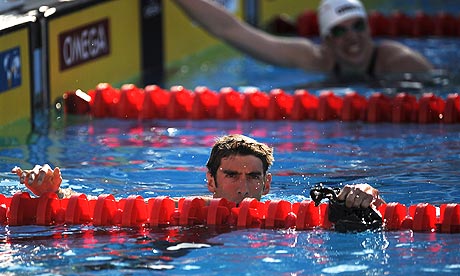
The chaos over the controversial "supersuits" that has engulfed yesterday continued a suffered his first defeat in five years in the 200m freestyle just after the world governing body announced it would ban the costumes.

Britain's Gemma Spofforth won gold at the world championships in the women's 100m backstroke, setting a world record in the process, but the defeat of Phelps sent shockwaves through the sport and his coach, Bob Bowman, said the American would not swim again until the issue was resolved. "Bob sorts my schedule," confirmed a distraught Phelps. Both Phelps and Spofforth were wearing Speedo LZR suits, which are being superceded by the new generation of wetsuit-style costumes made by adidas, Arena and others. From next year all will become illegal but Phelps was beaten by Paul Biedermann, a German wearing an Arena X-glide suit. Bowman said that Fina had better "do something or they're going to lose their guy who fills these seats."

The new regulations announced yesterday will limit the size of the suits and restrict the materials from which they are made to "textiles". There are numerous difficulties with the decision. First, Fina, the sport's governing body, cannot say when these changes will occur, their heavily-qualified estimate being "by April 2010". And secondly, Fina has yet to reveal what the term "textiles" actually means. Additionally, the rule change is in effect only a bye-law, which means the decision can be reversed at any point.

Fina insists that will not happen but it has already banned the new generation of swimsuits once this year only to change its mind after coming under heavy pressure from manufacturers and sponsors. Controversially, the records set in the new suits will stand. Fifteen world records have been set so far in Rome but not all in the new generation of suits. "Remember," said Fina's executive director Cornel Marculescu last night, "the world records are being broken here because these people are fantastic athletes."

Tell that to Michael Phelps. The greatest Olympian swimmer in history with 14 golds was not just beaten in the 200m, he was thrashed. Biedermann shattered Phelps' world mark of 1min 42. 96sec with a time of 1min 42sec. Phelps said: "I look forward to racing Biedermann next summer. It will be fun when swimming gets back to swimming." Of his race, done in a time of 1:43.22, Phelps added: "Theoretically it was a pretty good swim for me. Three tenths off my best time after taking six months off. I'm not happy but I know I didn't train much this year."Biedermann was understandably ecstatic, saying: "It's still hard for me to believe that I defeated a legend like Phelps. It is true that he has been training only for six months and he is not the same as at the Beijing Olympics. But the German team which I am part of is great." Biedermann finished a distant fifth behind Phelps in the 200m final in Beijing. Ten months on he trimmed four full seconds from his time.

The technology has moved on so quickly that Phelps' Speedo LZR seems almost obsolete. Or it did until the very next race, when Spofforth broke the world record by 0.36 of a second with a time of 58.12sec. It was the first gold won by a swimmer in a Speedo suit in Rome. The LZR is only partially polyurethane, whereas the new suits are fully coated with the material. That makes them water-impermeable, adding a huge amount of buoyancy.

He may well stay that way too, because Fina's announcement has taken back the technology used in swimming by a full decade. Marculescu insisted the sport was "evolving" but in truth it is a regression. With the new restrictions in place it will be a long time before anyone swims as fast as many have at these championships
M Abdul Rehman

Heavy guns and small arms fire pounded the besieged compound of the Boko Haram group, which styled itself on the Taliban and wanted strict Sharia introduced across Nigeria.

Helicopters swooped over the organisation's base in the city of Maiduguri yesterday, flushing out followers who were gunned down as they fled. Witnesses reported seeing bodies littering the mosque compound. We spotted dozens of members of Boko Haram fleeing," said Hamad Bulunkutu, a Maiduguri resident. "They stopped by briefly, shaved their hair and beard and discarded their jellabiyah (white Arabic kaftans) for T-shirts and jeans."

Up to 200 were killed during the operation, adding to as many as 400 others who have died since the violence broke out on Sunday.

Similar police operations were going in at least two other northern Nigerian cities as the authorities acted on President Umaru Yar Adua's order to crush the group "once and for all".

Its leader, Muhammed Yusuf, is believed to have escaped as his house and headquarters in Maiduguri were shelled, but police sources said his deputy, Abubakar Shekau, had been killed.

Nigeria's Taliban, which has no known links to the Afghan insurgency, emerged seven years ago and began a series of attacks on the country's authorities, mostly police stations.

It said it would wage war on "immorality" and its strict interpretation of Islam called for "Western education" to be banned.

M Abdul Rehman

The Palin wars have erupted again inside the Republican Party. Leaks followed by trash-talking followed by recriminations.

The latest eruption began in Vanity Fair, with a lengthy article by Todd Purdum examining the Alaska governor's past and future. The controversy migrated instantly to the web and the blogs--it was, in fact, made for the viral communication of today's politics--and became even more intense, nasty and personal. Jonathan Martin provided the fullest account for Politico.

There are several elements to this controversy. One is over Palin and her fitness as a possible presidential candidate in 2012. The pretext is her suitability to have been John McCain's vice presidential nominee, but the real issue is the sharp division within the Republican Party over where she goes from here.

Another element of the controversy is the future of the party itself. How much must the GOP adapt and change to assure its vitality as a healthy alternative to the Democrats? Palin is only a proxy in this larger debate that is consuming many Republican strategists and elected officials.

Finally there is the after-action war over John McCain's failed presidential campaign that still rages among a handful of GOP insiders. To those who were on the inside, there was virtually no way for McCain to defeat Obama in a year when George W. Bush's approval rating was below 30 percent, when more than eight in 10 Americans thought the country was off track. To those on the outside, McCain's defeat may have been likely, but their view was aided by mismanagement and poor strategy atop the campaign.

The criticism of Palin in Vanity Fair, and the strong reaction by Palin defenders, echoed the breakdown that occurred at the end of the campaign. Never has there been such a moment of internecine warfare just as a losing candidate is exiting the stage as there was in the days following Obama's victory last November.

For several days, the two camps fired at one another at the expense of both Palin and McCain. The charges and countercharges aimed at Palin were, to many Republicans, shocking and inexcusable, a messy end to a dispiriting campaign. Would that it would have ended there. Instead the Palin controversy has become a staple of the Republican story in the months since.

There's no surprise that Palin remains a controversial figure with the public at large. Her performance in the campaign created a wide gulf in public opinion between those who found her fresh and appealing and those who found her shallow and unready. What has been surprising is the degree to which she has divided Republicans--at least Republican strategists, insiders and talking heads--and how virulent their disagreements have become.

This was that foundation upon which the latest exchanges have taken place, with William Kristol of the Weekly Standard and Steve Schmidt, who was one of McCain's top advisers, carrying on a public argument over whether Schmidt had privately criticized Palin in the Vanity Fair piece and whose credibility should most be called into question.

The exchanges were vicious, if perhaps of interest to a small community of GOP insiders. But they continue to keep alive the debate over Palin. She is, in the estimation of many Republicans and even some Democrats, the most charismatic Republican in the country. But she also has generated a small cadre of detractors inside the party who question her capacity and her judgment, particularly as a possible 2012 candidate.

Beyond Palin, however, is the question of whither the GOP. Schmidt caused a stir earlier this spring when he publicly urged the party to rethink its position on gay marriage. He argued that in a nation that is both more diverse and more tolerant, Republicans must not appear to be rigid in their judgments of how people live their lives.

Other Republican strategists who don't necessarily agree with Schmidt on that particular question nonetheless see the GOP as a shrinking enclave. They see a party that has lost its footing among moderates and independents in need of a major overhaul. They worry that, given present demographic trends, the party must modernize, as the British Conservative Party has done, or risk a long-term period in exile.

Others within the GOP family believe that a combination of a return to first principles, the addition of some fresh faces who can attractively repackage a conservative agenda and a few stumbles by President Obama will help start the GOP comeback.

They remember what happened after Bill Clinton won the White House and how Republicans hunkered down, created a wall of resistance to Clinton's agenda (particularly health care) and successfully stoked the anti-government sentiment around the country. The result was the landslide of 1994 that drove Democrats from power in Congress.

All of this comes together in the persona of Sarah Palin. She is an irresistible personality around whom the arguments about the Republican future will continue to swirl. Some of this is truly about Palin past and future, but the noise also symbolizes deeper arguments about a party attempting to regroup under difficult circumstances
M Abdul Rehman

Apple ignited the mobile software market and now others want to emulate its success, writes David Flynn.

There's no doubt the iPhone changed the way mobile phones are designed, sold and used. Yet Apple's stylish and seductively easy-to-use smartphone was the launch pad for something even more revolutionary: an online software store with programs to unleash the full potential of the modern mobile phone, making it a pocket computer.

Unlike the programs sold for desktops and laptops, these mobile phone applications or apps are small, fast, low-cost (if not free) and usually designed for a single task. And there are thousands: games, guides to restaurants and cafes, apps for travel and banking, news and weather, sports, hobbies and business tools.

There is, as the advertisements say, an app for just about everything and they're all on the App Store Apple's one-stop shop for browsing and downloading software for the iPhone.

Although almost none of the programs are written by Apple, the company provided the App Store as a kind of software supermarket in which an astounding number of the programs are free and most of those offered for sale cost less than $US5 ($6.20). The average price is $US2.65 and Apple takes a 30 per cent cut on all software sold through the store.

Apps can be downloaded directly over the high-speed 3G mobile network or using Apple's iTunes software on a Windows or Mac computer, with the programs transferred to the iPhone the next time the phone is connected to that computer. By making it easy to find, download and buy programs for your mobile phone, the App Store ignited the mobile software market.

There are now more than 65,000 programs listed on the App Store and, in its first year, users of the iPhone (and the iPod Touch, which can run the same apps) downloaded a staggering 1.5 billion programs.

And in the same way that the iPhone has prompted other manufacturers to release touchscreen phones with elegant and finger-friendly interfaces, the major players in the mobile phone market are also seeking to emulate the barnstorming success of the App Store as a way to serve up mobile software.

Potentially, the biggest competition to the iPhone's App Store will come from Nokia, which dominates the world's mobile phone market with a share of 38.6 per cent more than double that of its nearest rival, Samsung (16.2 per cent). By way of comparison, Apple holds a 1.1 per cent share of the mobile market.

Nokia also leads in the more specialised smartphone segment with 41.2 per cent, ahead of the iconic BlackBerry (20 per cent) and Apple (10.8 per cent). Nokia's Ovi Store, which launched last month at store.ovi.com, leverages mobile technology such as GPS receivers and trends in social networking to make the app store even more practical.

"This is not just a place to find applications," says the executive vice-president of services and software for Nokia, Niklas Savander.

"It's a smart store. It suggests things you might like and adds social location dynamics to show you relevant applications. It shows you what your friends have bought. And it changes the inventory based on where you are." In addition to software, podcasts and video will be offered.

The GPS receiver built into an increasing number of high-end mobile phones will showcase applications based on your location. Step off a plane at Charles de Gaulle Airport in Paris and Ovi will suggest a set of recommended apps such as currency converters, maps, "Instant French" language lessons plus city guides to the Paris metro, restaurants and bars. Nokia's travel content includes guides and video podcasts from Lonely Planet.
M Abdul Rehman

Mobile phones sales are the latest victim of the global recession.

Nokia, the world's biggest maker of mobile phones, saw its earnings plunge 66 percent for the three months ending in June, compared to the same time last year.

Sales of Nokia mobile phones fell 25 percent during that time, and officials say they expect global demand for mobile phones will continue to shrink.

The Finnish company says it is trying to counter the trend by producing phones that offer a variety of applications.

Rival Sony Ericsson is also being hit hard. The world's fifth largest mobile phone maker posted a fourth consecutive quarterly loss, with sales slipping 40 percent.

Industry analysts say many consumers, in both advanced and developing countries, are keeping their old phones longer.

The global recession has been especially difficult for many technology companies.

Earlier this week, Dell, the second biggest maker of personal computers, said it expects demand will continue to be weak. And Sun Microsystems, which makes server, powerful computers that make information and programs available to a network or the Internet, says it expects to post a larger loss than it initially forecast.

In contrast, Intel, the world's second biggest maker of computer chips says it thinks demand may have bottomed out and predicted stronger sales in the second half of the year.
M Abdul Rehman

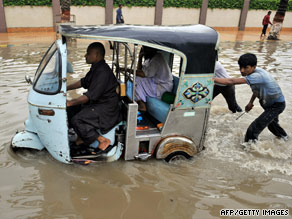
Officials combed the city looking for bodies. The health department confirmed 32 deaths and said it received reports of more.
"Most of them are either from drowning or they were deaths when the walls or roofs of their houses collapses," said Dr. A.D. Sajnani of the health department.
"The entire city is disrupted," said Muhammad Aly Balagamwala, a Karachi businessman. "Most places lost power for 28 to 30 hours, and some are still without power. The rain flooded offices. We lost water. Everything is shut down."
Many residents took to the streets to protest the massive power outage in the southern city. They threw rocks at the offices of the power company and burned tires.
"I guess there comes a point you just snap and you can't take it anymore," Balagamwala said. "To the credit of the government, a lot of cleanup work has been done since last night."
The rain began Friday night, and by Sunday the city had received almost 9 inches (22.9 cm), the most since 1977, said Mayor Syed Mustafa Kamal.
Storm drains overflowed, water-logging streets and alleyways.
Monsoon rains sweep across the subcontinent from June to September. While they bring much-needed relief to often-parched farmlands, they also leave a trail of landslides, home collapses and floods that sometimes claim dozens of lives
M Abdul Rehman
The teasers of Shashi and Sumit Mittal's new show on Star Plus, Sajan Ghar Jaana Hai are on air, and the latest development is that the show will be launching on 27th July, 2009. The show will be a fresh love story; the leads being fresh faces, Neha Saxena and Kunal Bhatia. The show will also see the comeback of Vidya Sinha to television. Others in the cast include, Abigael, Sanyojita Bhave, Tushi Sharma etc. According to our source, "27th July seems to be finalized for the launch of the show, but not much is clear about the time slot to be provided". However, future of three shows on the channel seems to be in jeopardy right now!! According to our source, "There is a buzz that the show might take up the time slot of either 8 PM, 8.30 PM or 10 PM. This only means that the future of Raja Ki Aayegi Baraat, Kis Desh Mein Hai Meraa Dil or Sabki Laadli Bebo is at stake". According to the ongoing story line, all the three above stated shows have a crisp and new track running; so there is a high chance that one of the shows will be shifted to the afternoon band to accommodate Sajan Ghar Jaana Hai.Says our source, "Since Sajan Ghar Jaana Hai is a high budget show, with a large set erected at Kurukshetra it is very unlikely that the channel will give it an afternoon slot instead of a good prime time slot". A source from Raja Ki Aayegi Baraat says, "We are working on a new track which has begun just now, and we have a long way to go. I have not heard of the show going off air or getting a change in time slot". Moving to Bebo, the buzz is strong that the show which opened with a great rating has not lived up to its expectations, and if there is no improvement in the TRPs, the show might be shifted to an afternoon slot. But our source from Bebo denies the news and says, "No, we have not heard of anything like this". Lastly, speaking of Kis Desh of Balaji Telefilms which has recently taken a six year leap, the show is now moving towards a fresh new love story of Heer and Prem with the entry of their little daughter, and there is no way in which the show could go off air right now!! However, if sources are to be believed, there is a high chance of Kis Desh being moved to an afternoon slot. An actor from Kis Desh on terms of anonymity also hinted to the same, saying "We have been hearing that there is a possibility of Kis Desh moving to an afternoon slot. But nothing is finalized as of now". If sources are to be believed, Siddhant Cinevision's Shraddha will be the next launch on Star Plus after Sajan Ghar Jaana Hai. But the question mark with the time slot prevails for this show too. Earlier, it was reported that Shraddha will be put in an afternoon band, but there are chances for the show to take up a prime time slot too.As of now, let's leave it to time and see which existing shows get the axe at the cost of the new shows coming in!!
M Abdul Rehman

STAR Plus, Hindi General Entertainment Channel presents yet another path breaking show Sach ka Saamna, where contestants will reveal their life's truthful moments in front of their loved ones, and go through their lives' biggest 'sacchai ki agnipariksha'. Beginning from Wednesday, July 15th at 10:30 pm the show will be hosted by the suave actor Rajeev Khandelwal and produced by Siddharth Basu's BIG Synergy Adlabs.Sach ki Agnipariksha begins with a brave heart lady Smita Matai, who is also the first woman contestant on the show. Smita, a research associate working on school curriculums makes some startling revelations as she moves from level to level answering each question with a lot of courage and dignity. Will Smita be able to answer questions relating to her husband? Will Smita reveal her deepest dark secret? Catch the same palpable excitement, fearful anxiety and a huge adrenaline rush for the first time on Indian television on Wednesday July 15th @ 10.30pm.From nail biting anxiety to answers that will almost have you fall off your chairs, the show has kept the bout of anxiety high with each contestant. 'Sach Ka Samna' has been adapted from an internationally acclaimed show called Moment of Truth. The Hindi version will be hard hitting as contestants boldly share their bitter truths but the show has been crafted keeping in mind the Indian sensibilities.
M Abdul Rehman

It's celebration time at Subhash Chandra's Zee Entertainment Enterprises Ltd (ZEEL) as its flagship Hindi general entertainment channel (GEC) Zee TV has become the genre leader among the dozen Hindi channels, pushing the leader STAR Plus to number three position behind Colors.
The rankings are based on viewership ratings data for week 26 (ended June 28) released by TAM Media, the viewership ratings agency whose data form the basis on which advertisers put their money on television. And the Hindi general entertainment genre is important because it contributes nearly half of the Rs 8,000 crore of advertising revenue that is generated on television annually, with the bulk coming from players like STAR Plus and Zee TV, among others.
It is also significant because genre-leader STAR Plus has been pushed to the number three spot for the first time in over a decade. It is ranked behind Colors that has managed to retain its number two spot for most weeks in the current year.
According to the TAM data, not only has Zee TV become the number one channel based on the gross rating points (GRPs), it has emerged as the leader in prime time (7pm to 11:30 pm), weekend prime time and the afternoon band (Monday to Friday), beating both STAR Plus and Colors.
According to the TAM data for week 26 of 2009, Zee TV has got a GRP of 243.1, ahead of Colors (242.8) and STAR Plus (218.5). Zee TV leads the prime-time band (Monday to Friday) with a total GRP of 113, ahead of STAR Plus (103 GRP) and Colors (100 GRP). Zee TV has also emerged as a leader in the weekend prime-time (Saturday and Sunday) slot with a total GRP of 23, while Colors (19 GRP) and STAR Plus (17 GRP) stood at number two and three respectively.
The GRPs are the currency used by the media planners for determining the popularity and reach of entertainment channels. GRPs are arrived at by adding the programme ratings of all shows aired during the 24-hour period while the weekly GRPs are determined by adding the GRPs of all seven days in a week.
"We are happy to have emerged a clear genre leader based on our programming strength alone and not on airing movies or running content without commercial breaks. We are creating GRPs and not buying them," Nitin Vaidya, COO, ZEEL and business head of Zee TV, said.
When contacted, a spokesperson for STAR Plus said: "It is a dynamic situation but as far as we are concerned the viewer-loyalty has always been with us. Our show Bidaai... continues to be the top rated show among all Hindi entertainment channels. We will soon be launching two more big-ticket shows."
A top executive of Colors said: "The TAM data puts both us and Zee TV at the same position — we have a GRP of 242.8, which is interpreted as 243, the same as them. But the main point is that we have been a consistent number two player. We were even the leader for a couple of weeks."
Reacting to this, Vaidya of Zee TV said: "We are a 17-year old company that has stuck to the basic business fundamentals of entertainment for the viewers, mileage for the advertisers and value for our shareholders. We are not in a hurry to grab rankings, but the TAM data clearly establishes us as the leader in all time-bands."
But are media planners excited about the new leader in the entertainment genre? "We are happy for Zee. But we don't buy slots on channels based on their weekly performance. I think, the next four-months will be crucial for Zee, STAR and Colors as a lot of new shows will come in," says Shashi Sinha, CEO of Loadstar Media, a leading media agency.
According to industry sources, at least 8-10 new telly-shows will be launched between Zee TV, STAR Plus and Colors in next few months and the media planners are expected to look at them for buying ad slots for their clients.
"Zee's TRP have seen a steady improvement since week one of CY2009. More importantly the contribution to these ratings is less dependent on movies unlike its peers which get a relatively higher share of their overall ratings from movies. Some of their new shows like Choti Bahu and Agle Janam seems to be getting the desired viewership and inching up the charts in the Top 10 shows in the Hindi GEC space," Mihir Shah,media analyst, Prahudas Liladher, said.
Zee TV's gain in GRP has been from a combined effort of at least five shows that have generated higher ratings. They include Choti Bahu, Aapki Antara, Pavitra Rishta, Agle Janam... and Saregamapa Lil Champs, a top Zee TV executive said.
M Abdul Rehman

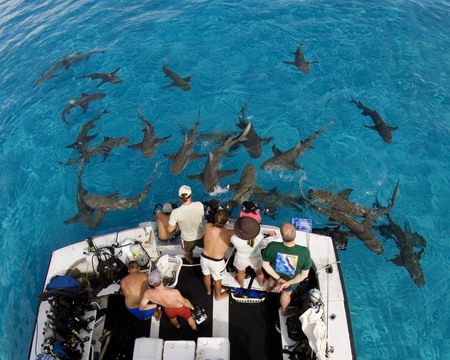
Photographer Eric H. Cheng and his team cast baits to attract sharks for their photographing at Grand Bahama Bank, Bahamas Wednesday July 8, 2009. The underwater photographer, spending the last five years photographing lemon sharks in Bahamas, gives a unique close-up and personal perspective of Lemon sharks. To get these images Eric once positioned himself underwater amid a food-fighting frenzy of up to 30 sharks. [CFP]
M Abdul Rehman

"The presidency of the EU condemns today's bomb attacks in Jakarta that have killed and injured so many innocent people," the Swedish government, current holder of the European Union's presidency, said in a statement.

"The EU conveys its deepest sympathy and condolences to the families of the victims of these brutal acts. We stand in sympathy and in solidarity with the Indonesian government and the Indonesian people in this most difficult time," the statement added.

US Secretary of State Hillary Clinton, en route to Asia for talks in India and Thailand, condemned what she called the "senseless" attacks, underlining that the threat of terrorism remains "very real".

"We condemn these senseless acts of violence and stand ready to provide assistance if the Indonesian government requests us to do so," she said. "The attacks reflect the viciousness of violent extremists, and remind us that the threat of terrorism remains very real," Clinton said.

In Paris, the French government said it condemned the double attack "in the strongest terms" and offered the victims' families and the Indonesian government its support and solidarity.

"France stands by the side of Indonesia, a major partner for our country in Asia, in its courageous fight against terrorism," the foreign ministry said in a statement.

France "offers its full support to the determined efforts of the Indonesian authorities to promote the stability of this great democracy," it said.

Australian Prime Minister Kevin Rudd said the blasts, in which at least two of his countrymen were wounded, made him "sick to the stomach".

"Any attack anywhere is an attack on us all," Rudd told reporters. "Any terrorist attack on our friends Indonesia is an attack on our neighbors. Any terrorist attack is an act of cowardice. It is an act of murder. It is a barbaric act that violates the fundamental principles of human decency."

M Abdul Rehman

The federal ministry of environment planted mangrove saplings ‘Rhizophora Mucronata’ on the coastal island on ‘Khedewari’ along the shores of Keti Bandar in Thatta district.

The tree plantation drive was organised by the ministry in cooperation with the Sindh forest department and local people and in financial coordination with the National Bank of Pakistan.

The earlier record was set by India on June 12 and 13 when 447,874 saplings were planted in Assam. Before that Mexico had planted 3,48,393 saplings on Aug 29 and 30 last year.

The task was accomplished by over 300 local volunteers who were divided in groups of 20, each supervised by one forest manager and helped by other designated persons. Within the first hour, they planted 97,000 saplings.

Federal Minister for Environment Hamidullah Jan Afridi, provincial ministers Asghar Taqi and Sassui Palijo and Inspector General Forests Dr Mohammad Iqbal Siyal were present on the occasion.

MNA Marvi Memon and IUCN’s representative in Pakistan Tahir Qureshi acted as observers.

Adil Ahmed, the Adjudicator of Guinness Book of World Records, Pakistan, who had monitored and assessed the world records in India and Mexico, also visited the site.

He told newsmen that the process of enlistment in the Guinness Book would be carried out after a reassessment of plantation.

Ms Palijo and Ms Memon, who hail from Keti Bandar, told Dawn that the event was a healthy achievement. They said non-release of sweat water into Indus downstream Kotri for a couple of years had resulted in the diminishing of mangroves.

APP adds: The task was accomplished five hours before sunset. It was expected that the number of saplings would exceed 600,000 by the end of the event.

The plantation was organised as part of a series of events planned by the ministry to mark the National Year of Environment.

In view of global significance of mangrove forests, particularly in the context of the tsunami of 2005, the event was planned in the mangrove areas on the coastal island, which are devoid of vegetation.

The head of WWF International and secretary general of International Ramsar Convention on Wetland have congratulated the ministry of environment for setting the world record in tree plantation.

They lauded the efforts of the environment minister who took national and international environment organisations on board and made the event a success.

An official said: ‘The ministry will look after the site for three years to ensure maximum survival of saplings.’

The ministry has initiated Rs13.5 billion projects in the forestry sector in the four provinces, Azad Kashmir, Northern Areas and Fata to increase the forest cover by 1 per cent under the Millennium Development Goals till 2015.
M Abdul Rehman

The tough three-day negotiations concluded here on Wednesday, with the World Bank Mission expressing concern over the government’s resolution to pass on the subsidies to the power consumers.

Currently, the government was providing Rs122 billion subsidy to the consumer on electricity.

The officials, who participated in the negotiations, told Dawn that the government had agreed to withdraw Rs55 billion in power subsidies during the current fiscal year.

However, the schedule for power tariff raise had not yet been finalised, the officials added.

The World Bank and the ADB teams finally agreed that subsidies worth Rs67 billion on electricity could be given during this fiscal year with Rs55 billion cushion provided by the IMF and that would be diverted from the development budget.

While, the government would provide 100 mmcfd gas for power generation that would be worth around Rs12 billion, sources said.

Adviser to the PM on Petroleum Dr Asim Hussain confirmed to Dawn that the new gas discoveries in the NWFP would be directed to the Pepco.

‘These new finds are expected to provide commercial production of 100 mmcfd gas,’ he said, adding that a summary would be presented to the ECC to seek approval for this allocation.

Responding to the World Bank concerns over continuing subsidies on electricity the Pakistan side maintained that tariff would be raised gradually linking it with the elimination of load-shedding.

The sources revealed that the tentative schedule for increasing electricity tariff would be five to seven per cent in the second quarter of 2009-10 followed by another 10 per cent in the third quarter.

M Abdul Rehman

SHARM EL-SHEIKH, Egypt, July 15 (Xinhua) -- The Non-Aligned Movement (NAM) leaders on Wednesday approved the admission of Argentina and the World Peace Council (WPC) as observers at the its 15th summit currently held in the Egyptian Red Sea resort of Sharm el-Sheikh.
According to a press release by the summit secretariat, the Coordinating Bureau of NAM agreed at a meeting on June 26 to submit the application of Argentina for being granted the observer status to the summit.

The bureau has also circulated the request of the WPC to be offered NAM observer status since July 6.

The bureau recommended that the summit endorse the applications of Argentina and the WPC.

The NAM groups 118 member states, including 53 from Africa, 38 from Asia, 26 from Latin America and the Caribbean and one from Europe (Belarus).

It represents nearly two-thirds of the United Nations' members, particularly developing countries, and comprises 55 percent of the world population.

The movement now has 16 observer countries and nine observer organizations.

Argentina is the second largest country in South America and eighth in the world by land area and the largest among Spanish-speaking nations, though Mexico, Colombia and Spain are more populous.

It is currently classified as an upper-middle income country or as a secondary emerging market by the World Bank. Argentina is also one of the G-20 major economies.

The WPC was formed in 1949, replacing the permanent committee of the World Peace Congress, in order to promote peaceful coexistence and nuclear disarmament.

The WPC was especially active in the areas bordering U.S. military installations in Western Europe, believed to house nuclear weapons. It waged large campaigns against U.S.-led military operations, especially against the Vietnam war.

The WPC had its headquarters in Helsinki of Finland until the 1990s when the Council moved to Greece. In the past, the WPC awarded the International Peace Prize.

In May 2004, the council held its world congress in Athens attended by representatives of 100 peace groups from around the world. The 2008 world congress of the council was held in the Venezuelan capital of Caracas from April 8 to 13. The 2008 congress showed a greatly increased membership of WPC with more than 120 peace groups from 76 countries in attendance.

M Abdul Rehman

Yao Lumei (right) presents a bunch of flowers to doctor Zhang Dekuan upon leaving No 23 PLA Hospital in Urumqi, capital of the Xinjiang Uygur autonomous region. Yao was injured during the July 5 riot and left hospital after her successful treatment yesterday. [Photo by Jiang Wenyao/China Daily] Almost two weeks after Xinjiang's deadliest riot in decades, most Urumqi residents feel secure again after tension has eased significantly in the city.

Now, for many in the autonomous region, another big step toward normality will come when the local government unblocks the Internet so they can go back online.

"No Internet in Xinjiang, no business for me," said Li Fenfa, an Urumqi resident who runs an online business selling dry fruit and who has seen no transactions for several days.

Online businesses have been among the hardest hit since authorities cut access to the Internet in most of the Xinjiang region following the July 5 riot that took the lives of almost 200 people.

Many online store owners have had to rely on friends in other parts of the country to post messages on their homepages telling potential buyers that business is on hold until after the Internet lockdown.

Professor Chen Lidan, a communications scholar at the Beijing-based Renmin University of China, said the government had blocked online access because that was the way instigators of the riots spread their messages and mobilized rioters.

Investigators believe overseas separatist groups used Internet tools including Tencent QQ and MSN, as well as social networking sites Twitter, Facebook and Xiaonei, to spread messages.

The Xinjiang government said it terminated Internet access to prevent the spread of the violence. Up to now, the only known public venue where the Internet could be found was the Hoi Tak Hotel, which was used as a base by reporters covering the riot's aftermath.

Some Web users have complained that their attempts to access Twitter and Facebook in other Chinese cities have also been unsuccessful. And Chinese portals, including Fanfou, which is similar to Twitter, have also been unavailable.

The government has not yet given a date when the services will be resumed.

"I believe most governments in the world will do something similar in times like these. But it is frustrating to know that I can't talk to my soccer club members after forum access was blocked," wrote John Ning, a self-proclaimed "Web freak" in Beijing.

Internet experts are now concerned that an extended "indistinctive Internet lockdown" may create new dilemmas for the government.

"The authorities probably think they are justified to cut off Internet on national security grounds, so they openly admitted it for the first time," said Hu Yong, a new media expert with the School of Journalism and Communication at Peking University.

But the lockdown has inevitably curtailed harmless Web activities, such as daily forums, information sharing and online shopping.

"Time after time, young Web users may grow doubts over the government's Internet policies, which will produce more profound impacts," Hu said.

China's young, whose daily lives often rotate around the Web, make up a large percentage of China's 300-million cyber population. They will "get discouraged" if they find their Internet space getting smaller, experts said while urging the government to use "wisdom of the masses" to deal with issues brought by new media.

"Blocking information should not be the first choice in an open society," said Yu Xiaofeng, director of non-traditional security and peaceful development studies at Zhejiang University. "The government should allow official and unofficial sources so that both the government and the public can seek truth through knowledge."

M Abdul Rehman

KARACHI (AFP) — Pakistan's cricket chief on Wednesday denied boycotting a meeting in India that handed the country's World Cup 2011 matches to co-hosts and called again for talks on winning back the fixtures.

The Central Organising Committee (COC) of the World Cup 2011 met in Mumbai on Tuesday and redistributed the 14 matches originally given to Pakistan. Eight went to India, four to Sri Lanka and two to Bangladesh.

Pakistan, which was stripped of its matches by the International Cricket Council (ICC) in April over security fears, was invited to the meeting as the fourth co-host but no Pakistan Cricket Board (PCB) representative attended.

PCB chairman Ijaz Butt denied Pakistan had refused to go to the event.

"No, we did not boycott the meeting," Butt told AFP. "Since it is a legal matter we do not want to make comment on that, but I can tell you that we are still trying to solve the matter through talks."

Butt said he was due to meet ICC chairman David Morgan on July 27 or 28.

"We are definitely trying to solve the matter out of court and I am going to meet the ICC president soon," said Butt, who last month threatened to sue the ICC, the COC and the IDI (ICC Development International).

Pakistan initiated legal proceedings after the ICC decided to strip it of its World Cup 2011 matches following the attack on the Sri Lankan team bus in Lahore last March.

The attack, which left seven players and their assistant coach injured and eight people dead, ended any immediate chance of Pakistan's hosting international cricket, with teams already refusing to tour over security fears.

A civil court in Lahore has given a stay order until July 30 against the relocation of the World Cup secretariat to Mumbai.

In an effort to resolve the matter through talks, the PCB put legal proceedings on hold and met several times with the co-hosts and ICC.

But a summit in England last month failed to find a solution.

The ICC ruled out the possibility of matches being staged in the United Arab Emirates, where Pakistan has previously played "home" internationals.

The COC on Tuesday also decided that it definitely wanted to keep the World Cup secretariat in Mumbai, a decision criticised by PCB legal adviser Taffazul Rizvi.

"I would not like to comment on the merit of the decisions made Tuesday because it's a legal matter, but keeping the central office in Mumbai is tantamount to contempt of court and will be brought to the knowledge of the court," Rizvi told AFP.

M Abdul Rehman

The heat is on LA’s drug docs as state and federal agents reportedly are running names, trying to zero in on who gave Michael Jackson the powerful surgical anesthesia suspected of killing him.

TMZ.com, the online celebrity gossip site that has led much of the coverage of the Gloved One’s death since breaking the news last month, reports the federal Drug Enforcement Administration is working with Teva Pharmaceuticals, the manufacturer of the Propofol found in Jacko’s rented manse, to track who bought it.

“Our sources say Teva looked at the lot number of the vial and found some of the vials in the lot went to AmerisourceBergen - a distributor of the drug. We’re told the DEA contacted AmerisourceBergen a few days ago and asked for all sales records of Propofol over a recent two-month period,” TMZ reported. “We’re told the DEA is looking to match doctors or other health care providers that obtained the drug with doctors who have some connection to Michael Jackson.”

Meanwhile, Us Weekly magazine has obtained video it says shows never-before-seen footage of Michael Jackson’s head catching on fire during filming of his 1984 Pepsi commercial. It shows him still dancing with his head aflame. People on the set tackle him to extinguish the fire. When Michael Jackson emerges from the pile of people trying to help him, the top of his head is bald.

The accident marked what would be the beginning of serious, lifelong pain for Jackson, who had been treated for painkiller addiction and has been described by relatives and friends as being hooked on pain medication at the time of his death.

In the ongoing investigation, California Attorney General Jerry Brown said yesterday his office has run dozens of doctors’ names, some of them thought to be aliases, through its prescription drug database. His office is assisting other agencies tracking down the drugs that may have killed the King of Pop.

“We’ve found some things, but this is early on” to provide details, Brown told Reuters. He said his investigators were given “dozens” of doctors’ names to run through its system by police probing Jackson’s sudden death, though some are considered to be aliases. he declined to say if murder or manslaughter charges could be brought in the case, but said it couldn’t be ruled out “any time you’ve got a dead body and you’ve got chemicals in large quantities.”

Jacko died at his rented Los Angeles mansion on June 25. Toxicology tests are still be conducted.

M Abdul Rehman

Michael Jackson was only 50 when he died, but his success spanned several half-generations. And each decade of his career left a distinctly different impression on his newest fans.

In the '60s and '70s, when he was with the Jackson 5, reciting his ABCs was as easy as 1-2-3. In the '80s, he thrilled the masses with "Thriller," the highest-grossing album ever, and countless millions of his adoring fans learned how to moonwalk. In the '90s and into the third millennium, the King of Pop became the King of Shock, alarming the world with allegations of child molestation, questionable marriages and the dangling of his baby from a hotel balcony.

"If you are 50 or below, you can't remember a time that Michael Jackson wasn't here," said freelance journalist Melinda Newman, a contributor to the entertainment Web site hitfix.com.

"He was always coming out with something new. But what was new never took away what he'd already done, so he was building a legacy of pop."

That legacy began in the Sixties, with the Jackson 5. The band of brothers — hailing from Gary, Ind. — got their big break in 1968 when they signed a record deal with Motown and one of the label's superstars, Diana Ross, took them under her wing.

"The appeal was the whole package of the five boys," said Newman. "From the start, he [Jackson] was front and center; there was a sweetness to his voice."

The boy band appeal quickly shifted to Jackson's talents as a stand-alone artist when he showed his clout as an actor in The Wiz. The following year, Jackson released his first solo album, "Off The Wall," but it wasn't until the 1983 release of "Thriller" that his solo career exploded.

Jackson was most prolific in the '80s: landing a Pepsi endorsement, fusing elements of rock and pop, and of course, doing his signature moonwalk, which he unveiled at the 25th anniversary celebration of Motown. The dance was mesmerizing. "No one had ever done something like that," explained Newman. "It was like watching someone do a trick that no one had ever seen before."

But toward the end of the '80s, Jackson's quirky lifestyle choices began to bewilder the public. He adopted a pet monkey named Bubbles, along with a variety of other exotic animals, and he also began a series of plastic surgeries. "He was like a big kid," Bryan Michael Stoller, Jackson's longtime friend and L.A. film director, told FOXNews.com. "He's always been like a big kid, very curious, very alive."

Newman said that Jackson's career appeared to be in a holding pattern in the '90s. "I think he was chasing the success that Thriller brought him, but couldn't duplicate," she said. "His popularity didn't wane, but he didn't have an album with as much success as Thriller had."

The '90s were filled with extravagant and lucrative world tours, and they also brought Jackson romance — or so he said — with the made-in-heaven marriage to Lisa Marie Presley, daughter of Elvis Presley, the megastar to whom Jackson was often compared. Jackson divorced Lisa Marie quickly and went on to become the father of three children — two with his second wife, Debbie Rowe, and the youngest with an unnamed surrogate.

Jackson's personal life became notorious in 1993, when he settled out of court with the family of a 13-year-old boy who accused him of molesting him.

"After the child molestation charges he became more of a recluse," said Newman. "I think he just needed to take himself out of the public eye ... he couldn't understand why people couldn't just be nice to him."

Although Jackson evolved throughout the decades, all generations could easily spot his humanitarian efforts. His close friend, Stoller, told FOXNews.com that Jackson would want to be remembered for making a difference in the world. "He started a lot of charities," Stoller said. "He was always thinking about others and the less fortunate."

Newman predicted that Jackson will likely be remembered for his contributions to music: "Much of the music was timeless," she explained. "It wasn't so much that he didn't age, it was the music that didn't age."

Dick Clark, a long-time friend of Jackson, released a statement Thursday about the King of Pop: "I knew Michael as a child and watched him grow over the years. Of all the thousands of entertainers I have worked with, Michael was THE most outstanding. Many have tried and will try to copy him, but his talent will never be matched. He was truly one-of-a-kind."

No matter what age his fans are, each generation can identify with this: "He let a lot of people know that their dreams could come true," Stoller said. "It could happen to anyone."